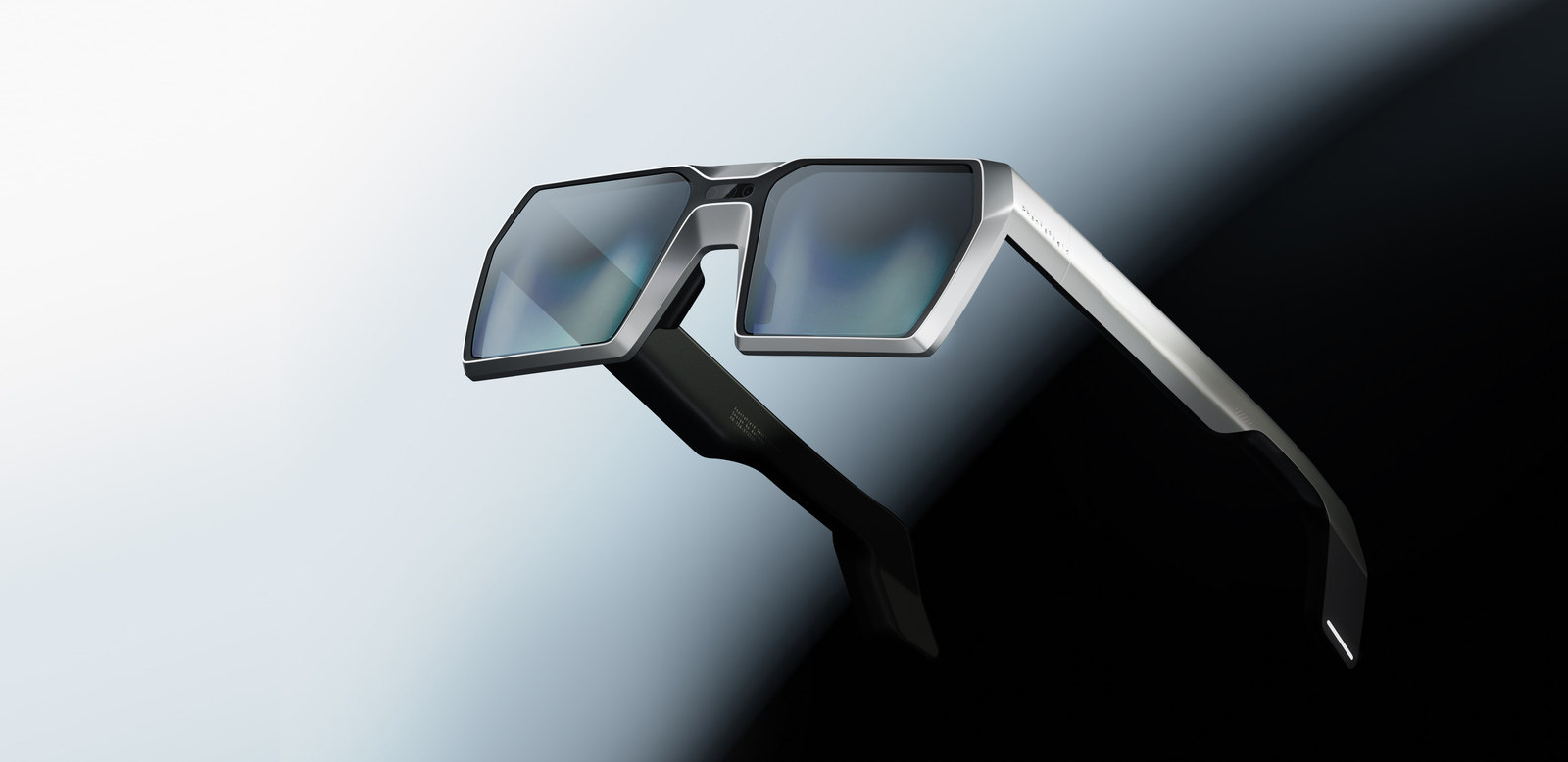
Today we opened early access to Seer glasses.
The vision
What a person and an AI can do together is limited by the bandwidth between them. A flat screen carries a small part of what the AI can make. Seer glasses give it your whole view, in depth, at the finest detail your eye can take in.
The AI on the other end should be yours. Your AI agent runs on the Pylon station, at home, on your own files.
It also makes what you watch. Tell your AI what you want. The AI on the Pylon station generates it, and the glasses show it in depth across your whole view. We call that a customized dream: a movie, a street to walk through, a game at console quality, created for you.
Cast your spell in your virtual universe. Your digital self will make it reality.
The Seer glasses page
Seer glasses expand your vision and accelerate the evolution of your consciousness, for the digital you and the physical you. The digital twin could be immortal with thepantheon.ai.
The lens
The display is the lens. Transparent micro-OLED pixels, switched by 2D TMD transistors, cover the whole of it: 16K × 8K pixels per lens, across a field of view of more than 100°.
Behind the pixels, a layer of liquid crystal is programmed into an array of tiny lenses. It aims each pixel's light into your eye from its own direction, so each part of the picture sits at its own depth. Room light passes through unchanged.
A second layer does the work of prescription lenses. It acts only on the light from the room, and one programmable layer serves any prescription.
In front, two polarizers with liquid crystal between them can darken any part of your view. That gives true black behind the picture, or the whole lens dark for virtual reality.
The Pylon station
The glasses carry the display. The computing stays at home, in the Pylon station. Inside is one customized Sophon chip with 256 tiers stacked, 64 for compute and 192 for memory. It has 2,000 GB of memory and 8,400 TFLOPS, and the whole AI model is held in the chip's own memory.
The Pylon station also powers the glasses. A photonic phased array on its front steers an infrared beam onto a small receiver on the brow bar and follows it as you move, up to 4.5 m (15 ft) away. A day of wear needs no cable.
The frame
The frame is one piece of stainless steel, thin and light, with the weight carried back along the temples and off your nose.
Early access
Early access is the Founding 3,141: 3,141 pairs, paid in full at $31,415 a pair, for the glasses and the Pylon station together. They ship first, in the order their payments arrive. After them, a Reserve order holds a pair with a 10% deposit. Either is refundable in full before shipping.
We plan to start deliveries in 2029. Nothing has shipped yet. The glasses and the Pylon station are in development, and the figures here are what we are designing them to do.
You can order at seer.glass.
Frequently asked questions
- What are Seer glasses?
- A pair of see-through glasses whose lenses are a light field display, with 16K × 8K pixels per lens across more than 100°. Each pair comes with a Pylon station, which does the computing at home.
- What is a light field display?
- A display that sends each pixel's light into your eye from its own direction, so each part of the picture sits at its own depth and your eye focuses on it as it would on a real object.
- What does the Pylon station do?
- It renders what the glasses show, runs your own AI agent on your own files, and powers the glasses over an infrared beam. Inside is one customized Sophon chip with 2,000 GB of memory and 8,400 TFLOPS.
- What is early access to Seer glasses?
- The 3,141 Founding pairs. A Founding order is paid in full at $31,415 a pair and ships before any Reserve order, in the order payments arrive.
- When will Seer glasses ship?
- Deliveries are planned from 2029. Founding pairs ship first, then Reserve pairs, each in order.