Every token a language model writes, a word or a piece of one, gets paid for twice: once in joules at the chip, and once in dollars by whoever asked for it. Our earlier posts counted the joules. This one counts the dollars. It asks what a data-center operator asks first: what does a megawatt earn in a year, filled with GPUs or with Sophon, our chip design?
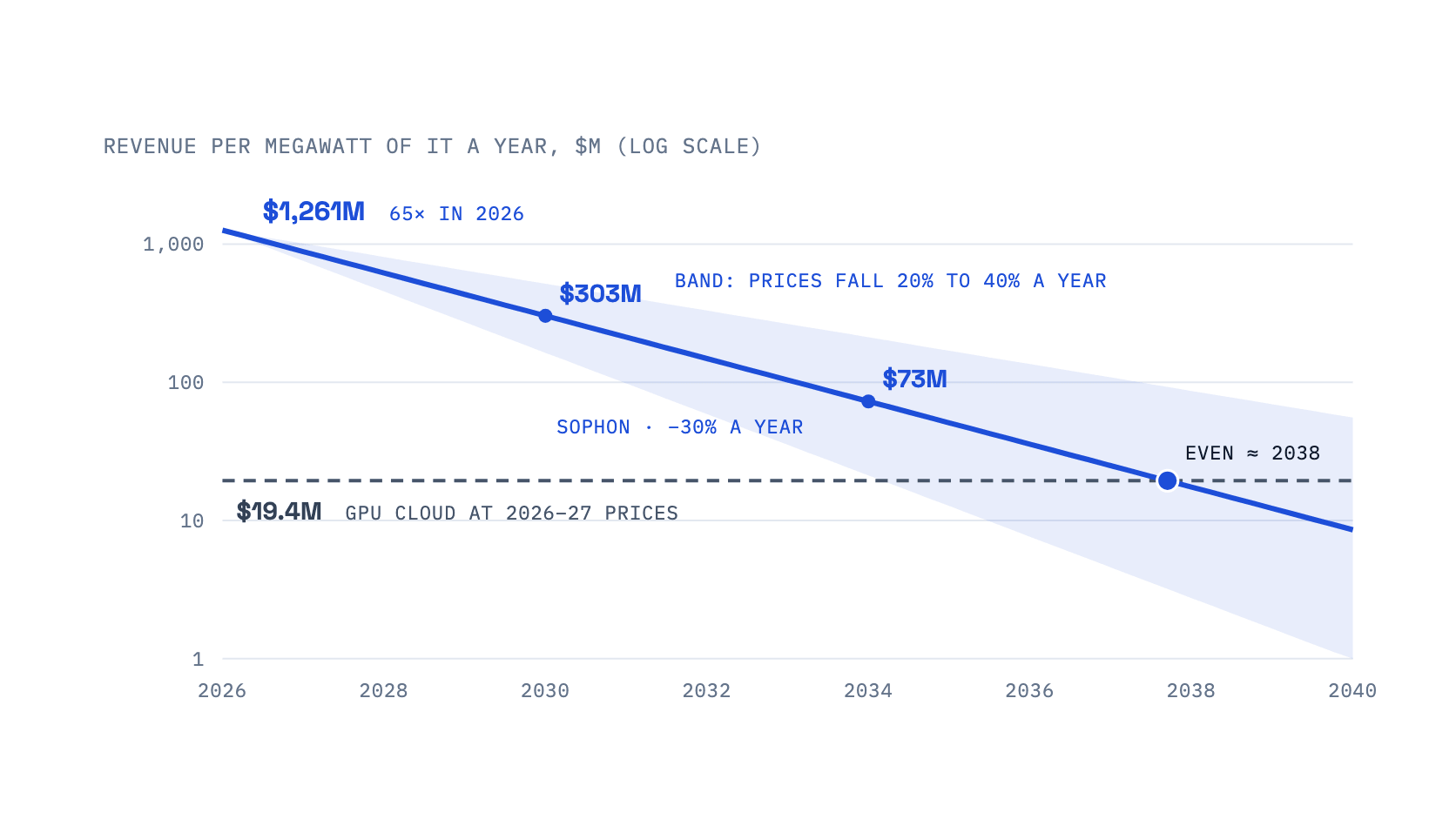
Our answer is now part of whitepaper §9. In our yardstick a GPU megawatt earns about $19.4 million a year. If buyers paid for speed in proportion, a Sophon megawatt would earn about 65 times that at 2026 prices, and falling token prices would wear the premium away by about 2038. That is our view, an illustration of one pricing rule, not a forecast.
The strongest objection is one anyone can check. Artificial Analysis, an independent site that benchmarks AI services, lists how fast each provider serves gpt-oss-120b, an open model any cloud can run. Cerebras, which builds a chip the size of a whole wafer, serves it at about 1,640 tokens a second. Together AI, on GPUs, serves it at about 107. If speed sold in proportion, Cerebras would charge 15 times as much. By list price, averaged over three tokens sent for each one written, it charges about 1.7 times. We come back to this below.
In our yardstick, a GPU megawatt earns about $19.4 million a year
Start with what clouds rent out today. Picture a cloud with 40 MW of IT load (the power delivered to the computers, before the building adds its cooling). It is built from NVIDIA's GB300 NVL72, a liquid-cooled rack of 72 GPUs, and has 296 of those racks at 135 kW each, 21,312 GPUs in all.
It sells 80% of its GPU-hours on six-year take-or-pay contracts at $4.00 an hour, with 97% of those hours billed. Take-or-pay means the customer pays for its hours whether it uses them or not. The other 20% is rented by the hour on demand, at an average of $8.00 actually collected, and 65% of those hours find a customer. Together that is about $774 million a year at 2026–27 prices, or $19.4 million per megawatt of IT.
Electricity at $85 a megawatt-hour, with a PUE of 1.15 (the building draws 1.15 watts from the grid for each watt the computers use), plus operations, comes to about $2.6 million per megawatt a year. That leaves about 85% of revenue as EBITDA, which is what remains after running costs and before interest, tax and the write-down of the hardware.
The contract price is the yardstick's soft spot. The research firm SemiAnalysis put the six-year fixed price near $4.00 in July 2026. IREN, a data-center operator, signed a five-year, $9.7 billion GB300 contract with Microsoft that works out near $2.90 an hour on our reading. IREN published no hourly price. By our sums, a $2.90 contract price, with on-demand held at $8.00, cuts every revenue figure in this post by about a fifth, GPU and Sophon alike. The comparison between them stays the same, and so does the year Sophon's premium runs out.
IREN's presentation of that contract shows an estimated 85% project margin after power, repairs and maintenance, close to ours. Its revenue is lower: about $1.94 billion a year over some 200 MW of IT, or about $9.7 million per megawatt, half our yardstick. On our reading, part of that gap is fewer GPUs per megawatt and part is the lower price.
Priced by speed, a watt of Sophon would earn about 65× a watt of GPU at 2026 prices
Sophon stacks 64 layers of atom-thin transistors on an ordinary 28 nm chip, a manufacturing generation more than a decade old. Half the layers compute and half are memory. A model's weights (the numbers it learned in training) sit a third of a micrometer above the circuits that use them. On a GPU they live in HBM, memory stacked beside the processor, and every new token means hauling all 80 GB of an 80-billion-weight model across.
That haul is most of why a GPU serving one request manages only about 0.22 tokens per joule (a joule is one watt for one second). Sophon gets 38.7: 14,438 tokens a second on 373 watts. That ratio, about 174 times, is the number on our home page.
A GPU cloud does not earn its rent one request at a time, though. It batches, fetching each weight once and using it for a couple of hundred requests in the same step. Run full, the newest GPUs, NVIDIA's Rubin and AMD's MI455X, reach about 30 and 37 tokens per joule. That cuts Sophon's lead to about 1.3 times and 1.05 times. Those figures are the GPUs' best case, their top output divided by their rated power. The rule uses the 1.3 against Rubin because a full batch is where the rent is earned (§5.A.5c shows the lead at every batch size).
What batching does not change is the speed of any one answer. On a GPU every request moves at about 300 tokens a second at best, and a fuller batch does not make it faster. A Sophon chip serving one request gives it 14,438, about 50 times as fast.
Picture a full GPU as a bus with two hundred seats. Each passenger burns little fuel and rides at bus speed. Sophon serving one request is a one-seat car that goes fifty times faster and burns slightly less fuel per passenger than the bus. An overnight pile of documents can ride the bus. An agent (software that has a model work through a task step by step) cannot, because each step waits for the last answer to finish. Neither can a long chain of reasoning or a voice assistant mid-conversation. For that work the wait is the cost.
Sophon does not trade efficiency for that speed. Its 38.7 tokens per joule hold when a chip serves a single request. The 50 times does come with two conditions. First, each Sophon chip has to serve one request at a time. Shared among eight, each request still gets about 1,800 tokens a second, six times a GPU's pace, and at about 48 requests a chip Sophon falls to the GPU's pace. Second, the GPU has to hold a whole copy of the model by itself. Split the model across several GPUs and each request goes faster.
Now the assumption. Suppose a token's price rises in step with the speed it arrives at. Against a GPU at full batch, a watt of Sophon serving one request per chip makes 1.3 times the tokens a watt of GPU makes. Each of those tokens is worth 50 times as much, so at 2026 prices the Sophon watt would earn 1.3 × 50 = 65 times as much. Both factors are rounded. Matched GPU by GPU, we get about 61 against Rubin and about 52 against the MI455X.
At our base case of 30% a year, falling token prices erase the premium around 2038
Token prices fall as GPUs improve, so the premium would shrink every year. We lower token prices 30% a year from 2026, the rate at which the research group Epoch AI finds GPU hardware getting cheaper for the same performance, and we run 20% and 40% as the range. Each year the 65-times multiple keeps 70% of its value from the year before, so 65 in 2026 becomes about 32 by 2028. We hold the GPU's $19.4 million at 2026–27 prices. The fall is already inside the Sophon multiple, and lowering both would count it twice.
Each year below is the year a megawatt is earning, not a launch date. A server that starts earning later starts lower on the curve. At 30% a year, a Sophon megawatt earning in 2028 would bring in about $618 million, nearly 32 times the GPU's $19.4 million. In 2030 it would bring in $303 million. By 2034 the lines are closing: $73 million, under four times the GPU. In 2038 it is about $17 million, just under the GPU, and the premium is gone.
The range is wide. If token prices fall 40% a year, the premium is gone around 2034. If they fall 20%, a megawatt would still earn about $87 million in 2038, and the premium lasts into the 2040s. The chart shows the whole curve with the band.
For a whole site, fill the same hypothetical 40 MW cloud with Sophon servers instead of GPUs, eight chips to a 3.5 kW server (437.5 W a chip once the rest of the server is counted). At 30% a year that illustrative site would bring in about $2.9 billion in 2034 and $1.4 billion in 2036. The GPU yardstick brings in $774 million at 2026–27 prices. Those Sophon figures assume every server is in place and earning at the rule for the whole year. They also assume buyers keep each chip busy with one fast request about 85% of the time, the use the rule's token price is built on. But the work that needs speed pauses between answers: agents wait on tools, and people pause mid-conversation. Filling those pauses means sharing a chip, and sharing lowers the speed, and so the price, each buyer gets.
Once the premium runs out, the rule keeps falling. By our sums it puts a Sophon megawatt at about $8.6 million by 2040 at 30% a year, against the GPU yardstick's $19.4 million. What is left then is any floor a contract sets, plus Sophon's lower cost to own (the whitepaper's Figure 13).
Within one vendor, faster costs nearly in step with speed; across vendors, speed comes cheap
We trust the price of speed least, so we checked it two ways. The first is retail. At 2026 prices the rule puts a Sophon token at about $1.4 per million, counting the whole server's power and assuming it is busy 85% of the time. Large providers charge roughly $0.6 to $1 per million for open models of about 70 billion weights (October 2026), and the cheapest resellers far less. So the rule asks a buyer for one and a half to two and a half times what large providers charge, in return for fifty times the speed.
That modest premium turns into 65 times because the two sides are counted at different points. The GPU cloud rents out hours. Spread over a full batch at the GPUs' best-case throughput, its rent comes to about 3 cents per million tokens by our sums, and fifty times that is the rule's $1.4. The rule, though, counts Sophon's tokens at what a buyer pays for them. A GPU cloud that sold its own tokens at retail would also take in far more than its rent. And a cloud that sells tokens carries the selling, the idle hours and the risk that buyers do not come. A landlord on six-year contracts leaves all of that to its tenants.
The second check is what buyers pay for speed today. Nobody sells a tier 50 times faster. Within one vendor, though, the price of a faster tier (a quicker, pricier way to call the same model) rises nearly in step with its speed. OpenAI and Anthropic each sell a fast mode at about twice the standard price for up to 2.5 times the speed. OpenAI's Ultrafast tier has been generally available since its DevDay conference at the end of September. It charges six times the price for up to six times the speed for developers calling it from their own software, and up to eight times in Codex, its coding agent.
Three cautions apply. Vendors promise speed ‘up to’ a ceiling. One independent test of only four runs a side measured OpenAI's priority tier, now called Fast, finishing jobs 1.47 times faster than standard (1.43 times the tokens a second), at twice the price on the rate card. Premiums also get competed down. Anthropic launched fast mode in February at six times the price for about 2.5 times the speed, and now charges twice on its newer models. And GPUs can sell speed too. OpenAI's GPT-6 Astra Ultrafast runs on NVIDIA's current Blackwell GPUs, though Ultrafast's first preview, in August, ran on Cerebras chips. On our reading a GPU buys that speed by giving each user more of the machine, so each watt serves fewer tokens. The buyer sees only the speed and the price.
Across vendors the premium is much thinner. Groq, SambaNova and Cerebras each build their own chips for fast answers. Against Together AI, with list prices averaged over three tokens sent for each token written, Groq charges the same price for 4.4 times the speed. SambaNova charges 1.2 times for 6.6 times, and Cerebras 1.7 times for 15.4 times. Together is also one of the slower GPU clouds on that page. Microsoft's Azure is the fastest GPU cloud listed, at about 370 tokens a second, and against it Cerebras is only about 4.4 times faster.
Stretch Cerebras's trade out to 50 times the speed and, on our sums, a token would fetch about 2.2 times a GPU cloud's retail price, about what the rule asks. The rule counts against a GPU's rent per token, though. On that basis the same premium gives a multiple between about 1.3 (Groq's pattern) and 3 (Cerebras's). In a middle case, where four times the speed fetches twice the price, it comes to about 9. Which of these a Sophon owner would collect depends on who sells the tokens and who carries the risk of selling them.
Buyers have committed to pay for speed at scale. In January 2026 OpenAI agreed to take about 750 MW of Cerebras computing built for fast answers, coming online through 2028.
Cerebras adds a dedicated low-latency inference solution to our platform.
Sachin Katti, OpenAI, in the OpenAI–Cerebras announcement, 14 January 2026
The two kinds of evidence do not weigh the same for whoever owns the chips. The same-vendor tiers are priced by the company that owns the model and sells it without a rival. A cloud serving open models sits where Groq, SambaNova and Cerebras sit. A cloud selling to a model maker gets whatever the two negotiate, and the model maker keeps its tier's premium. Buyers will pay for speed. Nobody can say whether that money goes to chips built for speed, or what a tier fifty times faster would fetch, until someone sells one.
The speed premium stays unproven until a much faster tier holds its price
Four signs would tell us the rule is holding. First, a tier ten or more times faster than standard would sell at close to ten times the price and keep that price after rivals answer. Second, speeds measured by outsiders would match the speeds promised. Third, agents and long reasoning chains would take a growing share of paid tokens, since that is the work that waits on each answer.
Fourth, token prices would fall no faster than hardware gets cheaper. Epoch AI's September 2026 study found the cost of reaching a fixed level of capability falling about 13-fold a year since 2023. That figure mixes smaller, better models and software with cheaper hardware, while the rule compares two machines running the same model. If better models drag the price of speed down too, the fall could be faster than even our 40% case, and the premium would be gone before 2034.
Until then, anyone planning around the rule should count only on what a contract guarantees, such as a floor at a GPU's revenue per megawatt, and treat everything above that as unproven. None of the Sophon figures has been measured on a finished chip; they are design numbers. Whitepaper §9 shows every equation and source behind the rule.
The bus will keep running, and it will keep getting cheaper. Our wager is on the riders who cannot wait for it.
Frequently asked questions
- Why does the rule use 1.3× and not the 174× on your home page?
- The 174× is the one-request case. When each chip serves a single request, one of the newest GPUs gives about 0.22 tokens per joule against Sophon's 38.7. GPU clouds earn their rental revenue running full batches of a couple of hundred requests. There Rubin reaches about 30 tokens per joule and the MI455X about 37, on the GPUs' best case. So the rule takes the full-batch lead over Rubin, about 1.3× (over the MI455X it is only 1.05×), and leans on speed per request for the rest.
- Is 65× a forecast of what a Sophon megawatt will earn?
- No. It comes from one pricing rule applied to the whitepaper's figures. Tokens are priced in proportion to the speed they arrive at and counted against a GPU's rent. Same-vendor fast tiers price speed close to that. Across vendors, on the same open model, buyers pay 1.0–1.7× Together AI's price for 4–15× its speed. Counted the rule's way, that pattern gives a multiple of about 1.3 to 3. Each year in the outlook is the year a megawatt would be earning under the rule, not a date for a product. Anyone planning around the rule should count only on what contracts guarantee, such as a floor at a GPU's revenue per megawatt (about $19.4 million a year at 2026–27 prices in our yardstick).
- Why hold the GPU line at 2026–27 prices while Sophon's falls?
- The 30% a year is our assumption for how fast token prices fall, set at the rate Epoch AI finds GPU hardware getting cheaper at fixed performance. That fall is already in the Sophon multiple, which is measured against a GPU at 2026 prices, so lowering the GPU line as well would count it twice. Read the GPU line as a fixed ruler. It does not say what GPU clouds will earn in 2038.
- What if the six-year contract price is nearer $2.90 an hour than $4.00?
- Then, with the on-demand price held at $8.00, the GPU yardstick falls by about a fifth. We work out roughly $15.4 million per megawatt a year. Running costs stay put, so the margin slips to about 83%. Every Sophon figure falls by the same share, because the rule is a multiple of the yardstick, so the multiples and the year the premium runs out do not change. The $2.90 is our reading of IREN's $9.7 billion Microsoft contract; IREN published no hourly price. IREN's own totals, about $1.94 billion a year over some 200 MW of IT, come to about $9.7 million per megawatt, half our yardstick. On our reading, part of that gap is fewer GPUs per megawatt and part is the lower price.
- Can't a GPU cloud sell speed as well?
- Yes. OpenAI's GPT-6 Astra Ultrafast, up to six times faster than standard in its API, runs on NVIDIA Blackwell GPUs. Changing the batch cannot make one request go faster than a GPU's single-request rate. To go faster, a GPU cloud splits a model across more GPUs and gives each user more of the machine, which on our reading costs it tokens per watt. Sophon would avoid that trade, because its 38.7 tokens per joule hold at one request per chip. The open question this post sets out is whether buyers will pay chips built for speed for that difference.
- Why measure Sophon against Rubin when the rents come from a GB300 fleet?
- GB300 is what clouds rent out today, so it sets today's rents. The 1.3× and the 50× are taken against the newer generation, NVIDIA's Rubin and AMD's MI455X. Their memory is faster than GB300's, so each of their users gets more tokens a second. Against a GB300 the speed gap would be wider, so on speed this is the harder comparison for us. The 65× multiplies two rounded figures taken mostly against Rubin. Matched GPU by GPU, we get about 61 against Rubin and about 52 against an MI455X. Treat 65 as a round number.
References
PhantaField, ‘PhantaField Sophon Whitepaper,’ Rev 4.2, October 2026 — §9, data-center revenue outlook (Figure 13b; references 37–40) and three-year cost of ownership (Figure 13); §5.A.5c, decode throughput and tokens per joule versus batch size. phantafield.com/whitepaper
Nishball, Cheang, Fong et al., ‘Nvidia GPU Debt Backstop Unleashes the AI Project Trinity: Capital, Offtake and Datacenters,’ SemiAnalysis newsletter, 6 July 2026 (current six-year fixed GPU rental price near $4.00 per GPU-hour).
IREN Limited, ‘IREN Secures $9.7bn AI Cloud Contract with Microsoft,’ press release (Exhibit 99.1: five-year term, about 200 MW of critical IT load) and investor presentation (Exhibit 99.2: about $1.94 billion annualized revenue; 85% estimated project EBITDA margin after power, repairs and maintenance), Form 8-K, US Securities and Exchange Commission, 3 November 2025. The ≈ $2.90 per GPU-hour and ≈ $9.7 million per MW of IT a year are our reading; IREN publishes no hourly price.
R. Rahman, ‘Performance per dollar improves around 30% each year,’ Epoch AI Data Insight, 23 October 2024.
Emberson and Roodman, ‘The plunging price of thought,’ Epoch AI, 22 September 2026.
Artificial Analysis, gpt-oss-120b API providers: output speed by provider (72-hour medians), accessed October 2026; list prices from the Together AI, Groq, SambaNova and Cerebras pricing pages, October 2026, averaged by PhantaField over three input tokens for each output token.
Artificial Analysis, Llama 3.3 70B API providers; Together AI and SambaNova pricing pages; OpenRouter endpoint listing for Llama 3.3 70B; all accessed October 2026 (retail prices for 70B-class open models).
OpenAI, API pricing page, Fast mode guide and Ultrafast mode guide, accessed October 2026; OpenAI Codex speed documentation, accessed October 2026; OpenAI Developer Community (Announcements), ‘Ultrafast is rolling out today for GPT-6.1 Sol in the API, Codex, and ChatGPT Work,’ 8 October 2026; OpenAI Developer Community, ‘DevDay 2026 announcements and developer resources,’ community forum summary, 29 September 2026.
Anthropic, Claude fast mode and pricing documentation, accessed October 2026; ‘Anthropic's new Claude Fast Mode trades your wallet for speed at a steep 6x markup,’ The Decoder, 8 February 2026.
M. Fultz, ‘When your Codex allowance runs out, use an API key instead of credits,’ WorkOS blog, 4 September 2026 (medians of four runs each).
D. Harris, ‘How NVIDIA GPUs Help Accelerate OpenAI's GPT-6 Astra Ultrafast,’ NVIDIA Blog, 1 October 2026.
‘OpenAI's new Ultrafast mode runs GPT-5.6 Sol 14 times faster, on Cerebras chips,’ The Next Web, 14 August 2026.
OpenAI, announcement of its partnership with Cerebras (about 750 MW, in tranches through 2028; remarks by Sachin Katti), 14 January 2026; Cerebras, ‘OpenAI Partners with Cerebras to Bring High-Speed Inference to the Mainstream,’ company blog, 14 January 2026; CNBC, report on the deal (more than $10 billion, per people close to the company), 14 January 2026.