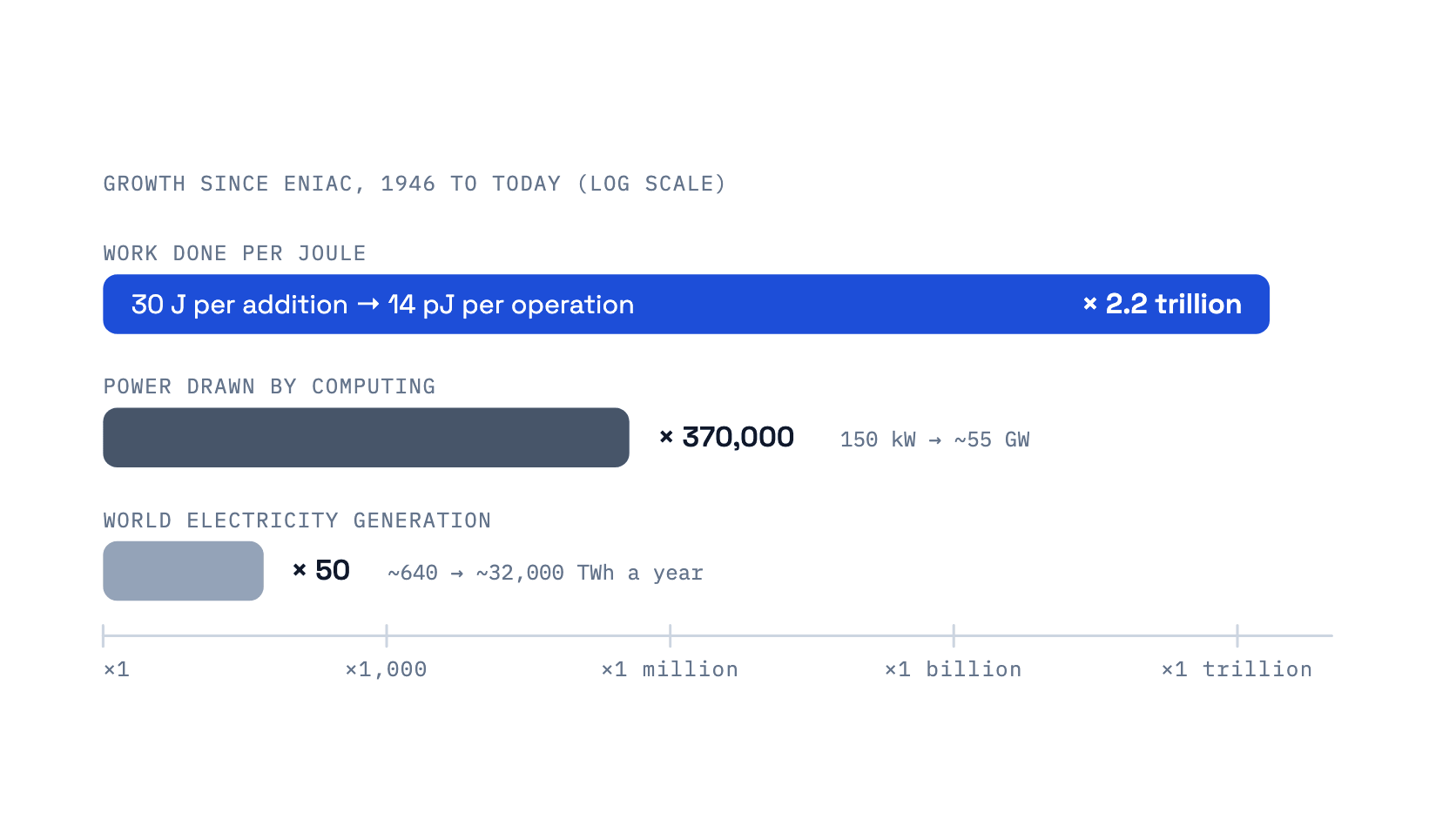
In February 1946 the US War Department unveiled ENIAC. By its own press release the machine had 18,000 vacuum tubes, weighed 30 tons and drew 150 kilowatts. For that it did 5,000 additions a second. The sum is short: 150,000 ÷ 5,000 = 30 joules per addition. Thirty joules is about what it takes to lift a 3 kg bag of flour one meter off the floor. One bag of flour, lifted, for every sum.
The most efficient supercomputer on the June 2026 Green500 list, KAIROS in Toulouse, does 73.28 billion floating-point operations (arithmetic on numbers carried to about sixteen digits) with one joule, or about 14 trillionths of a joule each. Divide 30 joules by that and you get about 2.2 trillion, which is twelve orders of magnitude: twelve factors of ten in a row.
Now the other column of the ledger. The world generated roughly 640 terawatt-hours of electricity in 1946 and about 32,000 in 2025, a rise of about fifty-fold. Computing's own draw grew far more than that: from one 150-kilowatt machine, which was close to all the electronic computing there was, to datacenters that together averaged about 55 gigawatts in 2025. That is between five and six orders of magnitude. Efficiency gave twelve. Counted in orders of magnitude, about two-thirds of computing's growth came from doing more with each joule and a third from using more joules.
We grow semiconductor sheets three atoms thick and design chips around them, and we think that ledger is the most useful fact in the argument about AI and power. Compute should scale by technology first and by electricity second. The largest waste in today's machines is the distance each number travels between memory and the circuit that uses it, and distances are shortened in a factory. Our aim is a chip that does with 100 megawatts what would take about 17.5 gigawatts of GPUs serving one request each (the arithmetic and its limits are further down). More power plants will be built, and should be. Technology is the lever that sets how much intelligence each gigawatt buys, and it can be pulled this decade.
A ruler for telescopes, and one that points down
Two rulers help explain the ledger. The first is Nikolai Kardashev's. In 1964, asking which alien radio transmitters we might detect, he sorted civilizations into three types by the energy they command: one at about Earth's level of the day, one with the output of its star, one with that of its galaxy.
Kardashev's scale was built for what a telescope can see, so it is blind to progress that happens inside a chip. Carl Sagan later turned the three types into a sliding scale, on which humanity rated about 0.7 in 1973 and rates about 0.73 today. A distant astronomer holding that ruler would have seen fifty years pass with almost nothing to log, and missed the twelve orders entirely. The scale is now also a statement of ambition: in a January 2026 application to the FCC for up to a million orbital datacenter satellites, SpaceX called the plan a first step toward a Kardashev Type II civilization.
The second ruler points the other way. In his 1998 book Impossibility, the English cosmologist John D. Barrow extended Kardashev's classification downward, ranking civilizations by the smallest thing they can manipulate. His ladder has seven rungs: objects of our own size, then genes, then molecules and their bonds, then individual atoms, the atomic nucleus, elementary particles, and at the bottom the structure of space and time. It is now usually called the Barrow scale. Barrow placed the humanity of 1998 barely on the atom rung and struggling with the nucleus, which we can split but have not mastered.
His reason for looking down was cost. Extending our reach downward in size, he wrote, has proved far cheaper than extending it upward. In a 2006 lecture at Gresham College in London he drew the consequence for energy: the most advanced civilizations might turn out to be extraordinarily small, with little energy used and little waste heat to shed.
It really rather pays to become small
John D. Barrow, lecture at Gresham College, London, 26 January 2006
Barrow did not apply his ladder to computing. That step is ours, and others have taken it too: a preprint posted in September 2026 by Volkan Gurses combines the two scales and puts the fall in the energy of one logic switch since 1950 at 11.7 orders of magnitude.
The ledger, held against Barrow's ladder
Hold the ledger against Barrow's ladder and the twelve orders stop looking like luck. In our reading, ENIAC was first-rung work, with tubes a person could pick up, joined by wire. Most generations after it controlled something smaller, and the joules per sum fell with the size. A rule set out by Robert Dennard in 1974 explained why. Shrink a transistor and lower its voltage in step, and each switch costs less energy while the chip runs no hotter. That rule broke around 2005 to 2007. By then the insulating film in a transistor's gate was about five atoms thick, and too leaky for the voltage to keep falling. Moore's law, the count of transistors, went on, but each shrink now saved far less power.
So computing had shrunk its parts to a few atoms' thickness without yet knowing how to build at that scale on purpose. As early as 1989 Don Eigler and Erhard Schweizer at IBM had moved 35 xenon atoms, one at a time, to spell the company's name. That proved atoms could be controlled; manufacturing with them was a long way off. In 2011 a group at EPFL in Switzerland showed a working transistor whose current ran through a single sheet of molybdenum disulfide 0.65 nanometers thick, three planes of atoms.
Since 2019, the other lever
AI grew up after Dennard's rule broke. Epoch AI tracked the leading AI supercomputers from 2019 to 2025: their performance grew 2.5 times a year, their energy efficiency 1.34 times a year, and their power draw doubled every year. Roughly a third of the growth came from efficiency and the rest from more chips and more electricity: the eighty-year ledger turned upside down. By the International Energy Agency's figures, a single rack of AI servers, the size of a refrigerator, drew about 13 kilowatts in 2020 and is planned to draw 600 by 2027, about what 500 average American homes use.
Jensen Huang said at NVIDIA's GTC in March 2025 that datacenters are power-limited, so an operator's revenue is set by its power. The constraint is real, and nobody is neglecting efficiency. The IEA finds the energy per AI task falling at least tenfold a year. That figure counts better models and software as well as better chips; the 1.34 is the hardware alone.
The difficulty is the clock more than the cost. By Huang's figure a gigawatt of AI datacenter costs about $50 billion to $60 billion to build. A gas plant to feed it costs about $2 billion to $2.5 billion at recent American prices. Electricity is the cheap part and, at this scale, the slow part: the IEA puts transformers at two to three years, and Lawrence Berkeley National Laboratory finds the typical American power plant finished in 2025 took over five years from requesting a grid connection to switching on. While you wait, your output is capped by what each watt you already have can do. Chips are the expensive part, and a new generation arrives every year or two. But each generation keeps the same plan: logic in one object, memory in another, and a trip between them. Changing the plan takes a new kind of transistor and a factory to make it. That takes years too, ours included, but once it exists the gain applies to every watt already connected.
Where a joule goes now
The Stanford engineer Mark Horowitz drew up a rough table in 2014 for 45-nanometer chips. Adding two small numbers cost 0.03 picojoules (a picojoule is a trillionth of a joule). Fetching one 64-bit number from DRAM, the standard memory chip, cost 1,300 to 2,600, or about 20 to 40 picojoules for every bit. The reason is wire. A wire stores charge along its whole length, and sending a bit means charging it, so the energy grows with the distance. At the same voltage, a bit sent one centimeter costs about 1,000 times a bit sent ten micrometers (wire alone; real links add more).
Jeff Dean, Google's chief scientist, put a number on it in a Y Combinator interview released in July 2026: a calculation costs about a picojoule, and bringing its data in from HBM, the memory stacked beside an AI accelerator, costs roughly 1,000 times that. Batching, which means serving many requests at once, exists to spread that cost. In today's machine the memory and the logic are made as separate objects and joined afterwards, so every number travels.
A sheet three atoms thick
Our machine, which we call NanoGalaxy PPMOCVD, grows a semiconductor sheet three atoms thick below 450 °C. Plasma does the chemistry that heat would otherwise do, and ultraviolet light heals the crystal as it forms. Silicon transistors are made near 1,000 °C, and the copper wiring on a finished chip is ruined above about 450 °C. So silicon memory cannot be built on top of finished logic; it is made separately and joined on afterwards, however closely. A cool process can grow a new transistor layer directly on a finished, wired chip. We control one dimension to the atom, the thickness of the film. We do not place atoms one by one, so Barrow's atom rung, in the full sense, is still ahead of us.
Sophon, our reference chip design, stacks 64 layers of such transistors, 32 computing and 32 memory, on an ordinary 28-nanometer silicon chip. Each layer, with its wiring, is about a third of a micrometer thick. The result is 330 GB of memory sitting among the circuits that do the multiplying, so a weight (one of the numbers a model learned in training) is read from a third of a micrometer above the circuit that needs it. The name comes from Liu Cixin's The Three-Body Problem, where a civilization etches a computer onto an unfolded proton.
Take a single request to a model with 80 billion weights. The model writes its answer one token, a fragment of a word, at a time, and consults every one of its weights for each. By our whitepaper's model, a GPU with the newest stacked memory (HBM4) answering that one request spends about 4.5 joules per token just fetching weights from the memory chips beside the processor: 80 billion weights × 8 bits × about 7 picojoules ≈ 4.5 joules. Sophon reads each weight from the layer directly above for 0.240 picojoules, multiplies for 0.070, and spends about 0.012 more on its on-chip network and leakage: 80 billion × 0.322 picojoules ≈ 25.8 millijoules. 4.5 ÷ 0.0258 ≈ 174. That ratio is where our line of roughly 17.5 gigawatts of computing with 100 megawatts of power comes from. It is the one-request case: every chip answering a single request as fast as it can.
A GPU has its own way around the trip: it batches, fetching each weight once for many requests. Shared among eight, the gap is still about twentyfold. Shared among about 48, one GPU puts out as many tokens as one Sophon chip. Run full, with a couple of hundred, it puts out about four times as many, and its energy per token comes within about 30% of ours. So against a full batch our gain per watt is small, and the 174 says nothing about training.
What batching does not change is the speed of any one answer. Each of those requests still moves at about 300 tokens a second (more only if the model is split across several GPUs), where a Sophon chip gives a single one 14,438. Our bet is that work which cannot go on until one answer is finished, the agent and the long chain of reasoning, will pay for that speed. None of this has been measured on a finished chip: these are design numbers, and the whitepaper shows every equation behind them and lists its own risks.
What efficiency does not do
The oldest objection is Jevons's, from 1865: more economical use of fuel does not mean less consumption. “The very contrary is the truth.” Google's recent record bears him out. Energy per median Gemini text prompt fell 33-fold in the twelve months to May 2025, which Google credits to better models and better use of its machines. In the twelve months after that, the tokens it processes each month went from about 480 trillion to over 3.2 quadrillion. The whole company's electricity, which also runs search, video and cloud, rose 37% in 2025. The periods do not line up and the electricity is not all AI, but the direction is plain: tokens multiplied several times over, and electricity rose by about a third.
Software and hardware gains multiply, and neither has reduced total electricity. At the sevenfold-a-year pace of Google's token count, even a hundredfold gain from any source is used up in under three years. So build the plants and the better chips. A plant costs about four cents for every dollar spent on the datacenter it feeds. Our question is about the dollar: whether it buys another generation of the same plan, with its trip between memory and logic, or a different one.
ENIAC lifted a bag of flour for every sum. Most of the distance since came from building smaller. The next stretch comes from building closer, and on Barrow's atom rung that work has barely begun.
Frequently asked questions
- What is the Barrow scale?
- It is a ranking of civilizations by the smallest thing they can manipulate, set out by the English cosmologist John D. Barrow in his 1998 book Impossibility as a downward extension of Kardashev's energy scale. Its seven rungs run from objects of our own size through genes, molecules, individual atoms, the atomic nucleus and elementary particles to the structure of space and time. The name, and the lengths often attached to each rung, come from later writers, notably Clément Vidal; Barrow gave no lengths and did not apply his ladder to computing.
- How is the Barrow scale different from the Kardashev scale?
- The Kardashev scale (1964) ranks a civilization by how much energy it commands, because that is what a distant telescope could detect; on Carl Sagan's later sliding version humanity, at about 19 terawatts, rates about 0.73. The Barrow scale ranks a civilization by how small a thing it can build and control. Barrow's stated reason for looking down was cost: extending control over smaller dimensions has been far cheaper than extending it over larger ones.
- Does more efficient AI reduce total electricity use?
- Historically, no. Google's energy per median Gemini text prompt fell 33-fold in the twelve months to May 2025; the company's electricity use nonetheless rose 37% in 2025, and the tokens it processes each month grew about sevenfold between May 2025 and May 2026. Efficiency sets how much computing each gigawatt buys, and it can improve while new power plants wait years for a grid connection.
- Does Sophon's 174-fold energy ratio apply to all AI workloads?
- No. It is the one-request case: energy per token when each chip answers a single request to an 80-billion-parameter model as fast as it can, against a GPU with HBM4 memory, by the whitepaper's model. A GPU closes nearly all of the gap by batching. About 48 requests sharing one GPU match one Sophon chip's output, and a full batch of a couple of hundred brings the GPU's energy per token within about 30% of Sophon's, though each request still moves at about 300 tokens a second. The ratio comes from shortening the trip each weight makes, and it does not describe training.
References
War Department, Bureau of Public Relations, ‘Physical Aspects, Operation of ENIAC Are Described,’ press release, 16 February 1946.
Green500 list, June 2026 (No. 1: KAIROS, CALMIP, Toulouse, 73.28 GFlops/W). top500.org
R. Pinto et al., ‘The rise and stall of world electricity efficiency: 1900–2017,’ Energy 269, 126775, 2023, as compiled by Our World in Data; Energy Institute, Statistical Review of World Energy, 2026.
International Energy Agency, Key Questions on Energy and AI, World Energy Outlook Special Report, April 2026.
N. S. Kardashev, ‘Transmission of Information by Extraterrestrial Civilizations,’ Soviet Astronomy 8, 217, 1964. Carl Sagan, The Cosmic Connection: An Extraterrestrial Perspective, Anchor Press/Doubleday, 1973.
Federal Communications Commission, Space Bureau, Public Notice DA 26-113 (SpaceX application for orbital data centers), 4 February 2026.
John D. Barrow, Impossibility: The Limits of Science and the Science of Limits, Oxford University Press, 1998, pp. 133–135; ‘Impossibility: The Limits of Science,’ lecture, Gresham College, London, 26 January 2006.
Clément Vidal, ‘Black Holes: Attractors for Intelligence?,’ arXiv:1104.4362, 2011. Volkan Gurses, ‘A technological capability scale for civilizations from the Kardashev and Barrow scales,’ arXiv:2609.35237, 28 September 2026 (preprint).
R. H. Dennard et al., ‘Design of ion-implanted MOSFET's with very small physical dimensions,’ IEEE Journal of Solid-State Circuits 9, 256, 1974. M. Bohr, ‘A 30 Year Retrospective on Dennard's MOSFET Scaling Paper,’ IEEE SSCS Newsletter, 2007.
D. M. Eigler and E. K. Schweizer, ‘Positioning single atoms with a scanning tunnelling microscope,’ Nature 344, 524, 1990. B. Radisavljevic et al., ‘Single-layer MoS₂ transistors,’ Nature Nanotechnology 6, 147, 2011.
Epoch AI, ‘Trends in AI Supercomputers,’ April 2025.
Jensen Huang, keynote, NVIDIA GTC, San Jose, 18 March 2025; NVIDIA Corp., Q2 fiscal 2026 earnings call, 27 August 2025.
Lawrence Berkeley National Laboratory, Queued Up, 2026 edition. John Ketchum (NextEra Energy), remarks at CERAWeek, March 2025, on the cost of new gas-fired generation.
Mark Horowitz, ‘Computing's Energy Problem (and what we can do about it),’ IEEE ISSCC, 2014.
Jeff Dean, ‘The 1% Rule for Building in AI,’ Y Combinator Startup Library, July 2026.
W. Stanley Jevons, The Coal Question, Macmillan, 1865 (quoted from the second edition, 1866, ch. VII).
C. Elsworth et al., ‘Measuring the environmental impact of delivering AI at Google Scale,’ arXiv:2508.15734, August 2025; Sundar Pichai, Google I/O keynotes, May 2025 and May 2026; Google, 2026 Environmental Report.
PhantaField, ‘PhantaField Sophon Whitepaper,’ Rev 4.1 — energy model §3.C–3.D (wire-energy ledger §C.1b), batch-size analysis §5.A.5c. phantafield.com/whitepaper