Dear Jensen,
We offer you the use of every technology PhantaField owns, free of charge. If something we’ve built can help you make the next generation of chips, we’d be glad to share it with you.
Professor Chenming Hu showed us what it means to move Moore’s law forward. He and his colleagues shaped a transistor’s channel into a thin fin so the gate could control the current from several sides. His work helped the industry scale from the 28 nm node to the 3 nm node and laid the groundwork for today’s NVIDIA chips. We’re following in his footsteps as we work to advance Moore’s law beyond 7 Å. In November 2023, he became PhantaField’s first investor.
We started by building a tool. Professor Hu’s investment helped fund our 300 mm tool, NanoGalaxy. It uses metal-organic chemical vapor deposition (MOCVD), assisted by plasma and ultraviolet light, to grow 2D TMD semiconductor films a few atoms thick. The growth temperature is low enough for the circuits already on the wafer. The new film can then be patterned into another layer of CMOS transistors.
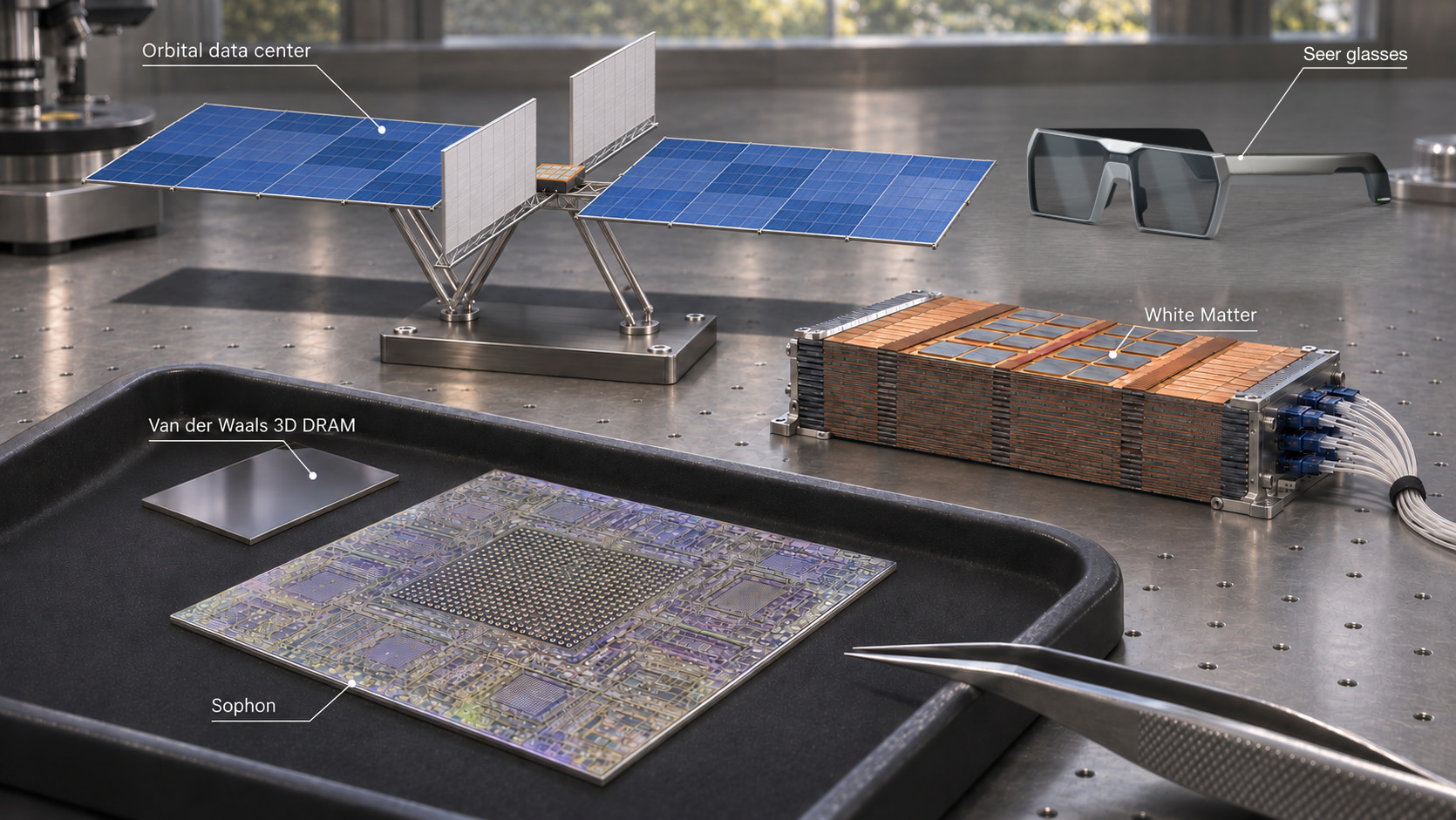
Our Van der Waals 3D DRAM design uses those layers for memory. Each cell uses two transistors to store and read a bit without a separate capacitor. Stacking the cells adds memory within the same chip footprint. A chipmaker could put a memory die beside a GPU, bond memory tiles underneath it, or grow memory directly on the processor wafer.
Sophon brings arithmetic into the stack. In our AI processor design, 32 memory layers alternate with 32 logic layers. A model weight can travel from its memory cell to the circuit directly beneath it for multiplication. The memory barrier is gone, and the chip can do more work with less energy.
White Matter addresses a problem we face when we put many chips together. How do we cool the dies in the middle? Our package design eliminates the need for a printed circuit board or a heavy copper block. Everything sits on a silicon interposer with channels etched into it for liquid coolant. The resulting block of silicon can fit three racks’ worth of chips into a space half the size of a shoebox.
As data center construction faces tighter restrictions in the United States, we believe Sophon and White Matter offer the best solution for computing in space. We estimate that the cost per token in orbit would be half that of a land-based data center. Our 2D TMD transistors are also more resistant to radiation than conventional transistors, so Sophon can run in orbit without the heavy shielding that a GPU needs. Our 2T0C memory cells are less likely to lose their contents in a radiation event, so Sophon can keep working when a GPU would have to stop and retry.
Seer glasses bring the idea home. Our 2D TMD semiconductors enable a transparent display on the lens. In our design, a customized Sophon in the Pylon station would run a personal AI and render what the wearer sees. We envision a new form of personal computing in which we can cast a spell in our own virtual universe and see it come to life.
Jensen, if you have time to sit down with us in Santa Clara, we’d be glad to show you what we’ve built and how it works. Whatever you choose to do, you’ll have our full support and free use of our technology.
With respect,
The PhantaField team