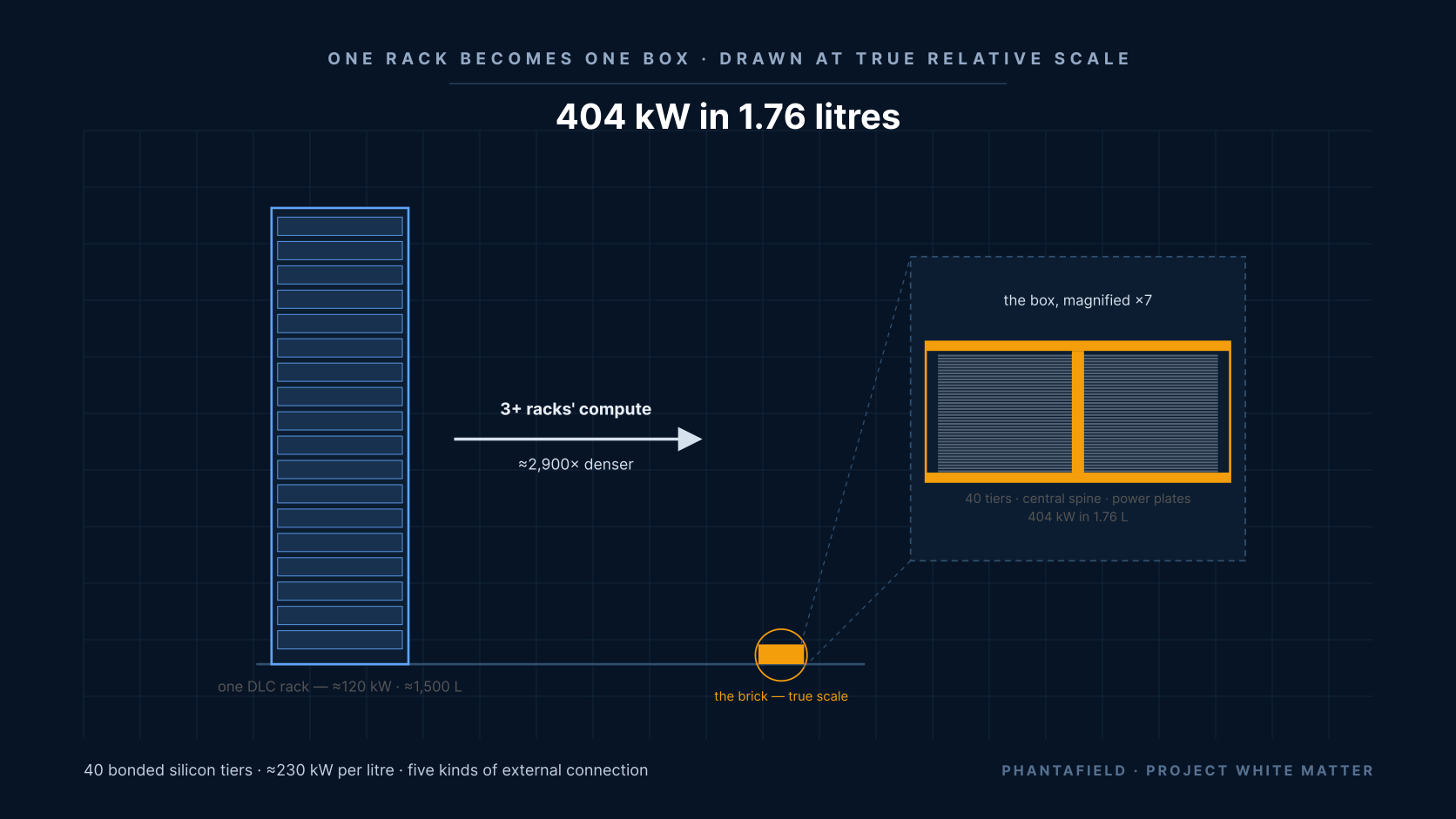
Walk into a liquid-cooled datacenter and most of what fills the hall is not silicon. It is the distance between the silicon: boards, cables, connectors, and the racks that hold them apart. A rack holds about 120 kW of compute in roughly 1,500 litres. White Matter puts more than three racks' worth — 404 kW — into 1.76 litres, by removing everything in between.
One rack becomes one box
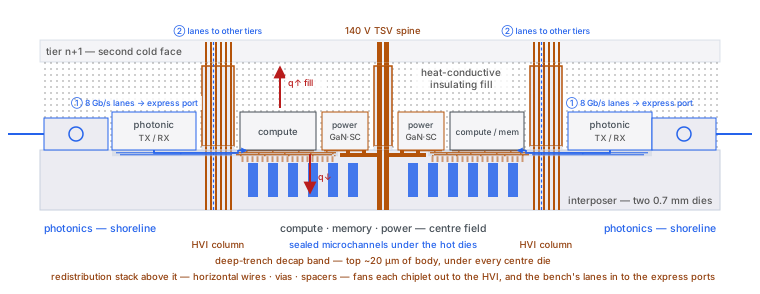
The brick is forty silicon interposer tiers, each about 100 by 200 millimetres, bonded into a sealed stack at a 2.2 mm pitch. Water runs through channels etched into the silicon itself and carries about 145 W/cm² off the dies above. Power arrives on a 140 V spine down the centre and is converted on each tier beside it, so the kiloamp rail exists only over millimetres. Light leaves from benches along the two narrow edges — 12.8 Tb/s a tier, 512 Tb/s a brick. Coolant in and out, power, ground, fiber: five kinds of connection, and the box is closed.
The rack was the ceiling
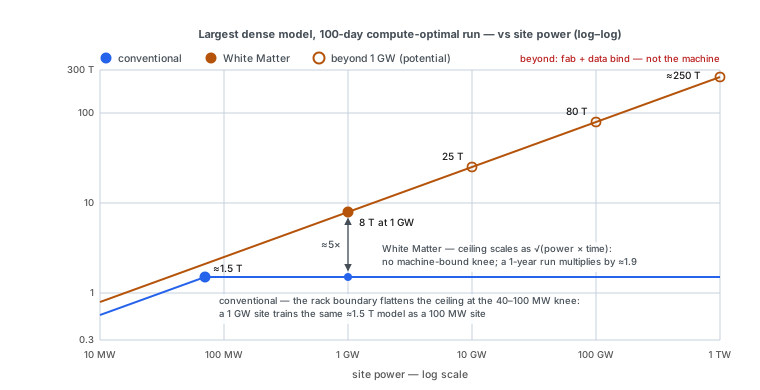
The largest model anyone can train is set by how much compute and memory can act coherently, inside one low-latency domain. Training is communication-bound before it is compute-bound, and every term of that communication grows with distance. In racks of boards and cables the coherent domain ends at the rack — eight to seventy-two accelerators — and everything past it is reached through switched optics at microsecond latency. So adding racks adds capacity, never capability: a gigawatt spent that way trains about the same 1.5 trillion-parameter dense model that 100 MW does.
From brick to room
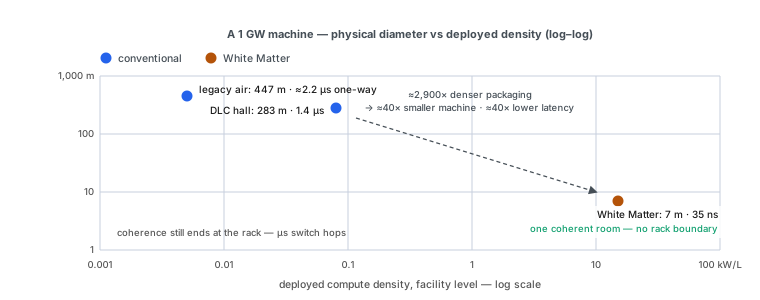
Thirty-two bricks slide into a frame the size of a rack: 12.9 MW, with liquid and 140 VDC arriving overhead and nothing converting in between — copper, pipe and fiber, not electronics. A gigawatt is about 2,475 bricks in 77 frames on a floor roughly ten metres by seven, every frame wired to every other through a passive shuffle with no switch in the path, about 35 nanoseconds from any brick to any other. The ceiling moves with the walls: about 8 trillion dense parameters per gigawatt, rising with the square root of site power, with petabyte-class coherent memory behind it. What binds after that is the grid, the fab and the data, which is as far as packaging can move the problem.
Where Sophon fits
White Matter is packaging, not a chip. It is designed at its envelope's physical limit for whatever class of silicon is put inside, and Sophon — our monolithic 3D accelerator, with 330 GB of memory in the compute array — is the die we plan to put there. Sophon removes the memory wall inside the die; White Matter removes the rack wall outside it.
White Matter is at concept feasibility, sizing grade. The numbers above are first-order engineering estimates computed inline from stated assumptions, not measurements of built hardware, and the whitepaper closes with its own risk register.
Read it
The whitepaper is published in full at phantafield.com/whitepaper/white-matter — the physics of the ceiling, the brick, the frame, the room fabric, and a candid section on what orbit does and does not buy. The product page tells the same story from brick to site, with the brick and the service frame drawn in three dimensions.
Frequently asked questions
- What is White Matter?
- A packaging architecture: a sealed brick of forty liquid-cooled silicon interposer tiers with in-package power conversion and co-packaged optics — 404 kW in 1.76 litres — plus the frame and fiber fabric that join bricks into one coherent machine.
- How is it different from a rack of GPUs?
- Density and connectivity. A liquid-cooled rack holds about 120 kW in roughly 1,500 litres and its coherent domain ends at the rack; White Matter packs about 2,900 times denser and joins bricks by point-to-point fiber with no switch, so a gigawatt room acts as one machine about 35 ns across.
- Does White Matter require Sophon?
- No. It hosts whatever class of silicon is put in it; Sophon is the die we plan to put inside.