SANTA CLARA, Calif. — The most consequential customer for AI silicon in the 2030s may not be a datacenter on Earth. SpaceX has spent two years talking openly about solar-powered compute in orbit — datacenters that sidestep the grid queues and cooling limits now throttling terrestrial buildouts — and its TeraFab project, a giant chip fab of its own, signals how seriously it intends to control the silicon that will fly. The economics push the same way: launch costs are collapsing while grid megawatts get scarcer, and at some crossover the cheapest place to run a token is above the atmosphere.
That migration has a filter at the door, and it is not FLOPS. It is radiation.
In orbit, radiation disqualifies conventional memory
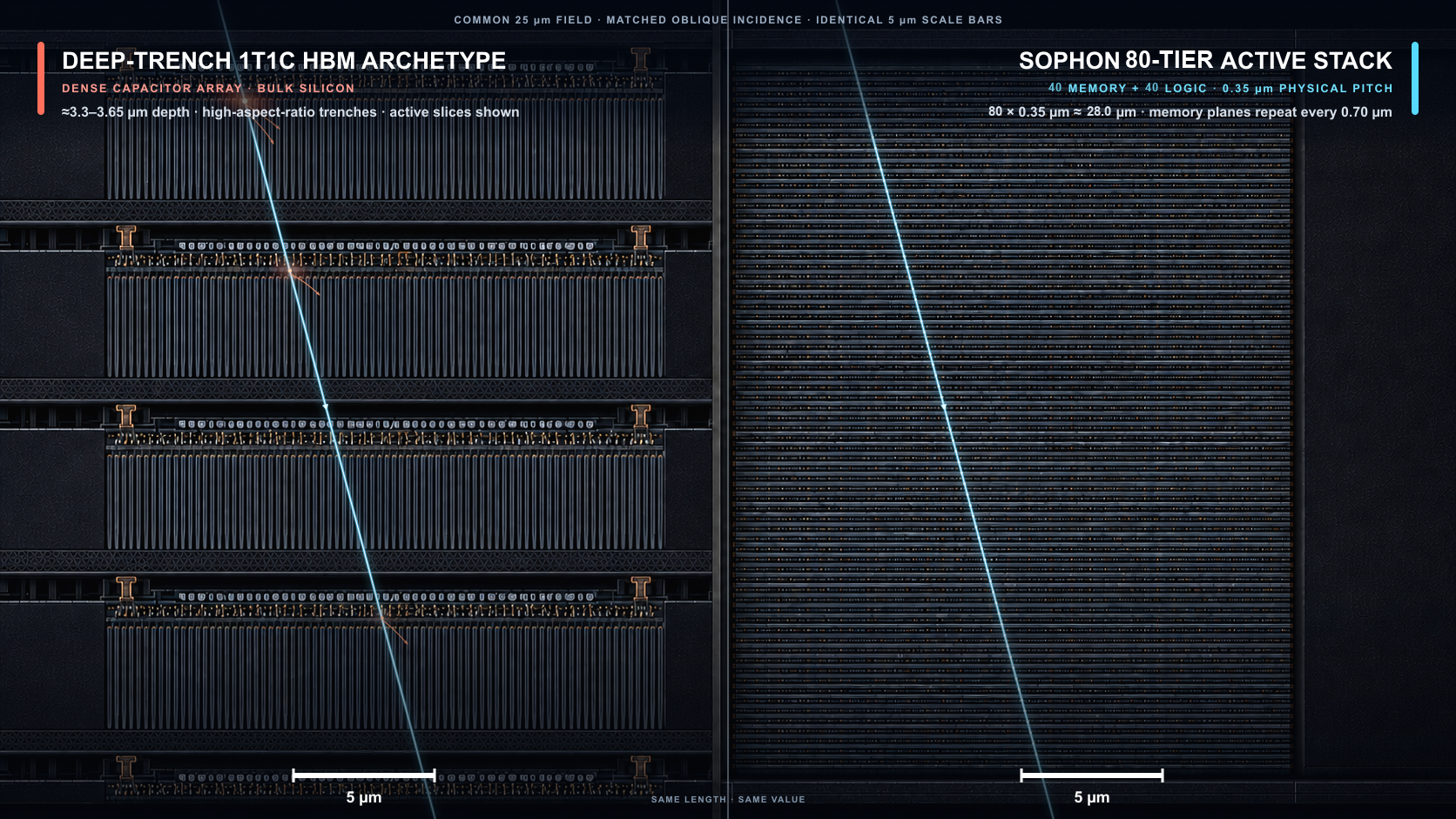
On the ground, cosmic rays are a statistical nuisance. In geosynchronous orbit they decide which architectures may exist. PhantaField's whitepaper quantifies it: a 1T1C DRAM cell — the cell inside every HBM stack — stores its bit on a capacitor whose junction collects charge from a micrometer of bulk silicon, so essentially every cosmic-ray ion, and even the recoils from trapped protons, can flip it. The modeled result: a single 288 GB HBM4 GPU suffers roughly 230 to 2,300 memory errors per day in GEO, with clustered multi-bit corruption, row and column failures, and the unhardened logic base die surviving past on-die ECC.
Sophon's cell lives in a different geometry. The capacitor-less 2T0C node sits at the third metal layer, and its only charge-collecting matter is a pair of atomically thin channels on dielectric — no bulk junction, no funnel. At near-normal incidence, the most ionizing ion in the galactic spectrum deposits about half the charge needed to flip the bit: the error cannot happen. For Sophon, an error requires a grazing hit — an ion skimming almost parallel to the atomically thin channel, within a few degrees of its plane. Strikes that rare flip at most 2.6 bits per day across the entire 330 GB array — against 230–2,300 errors for a single HBM4 GPU, a gap of three to four orders of magnitude — and each flipped bit lives at most one second, because the ordinary 1 Hz refresh doubles as an error-correction scrub.
Hundreds to thousands of memory errors a day on HBM; at most two or three on Sophon. In orbit, that is not a benchmark gap — it is the difference between a computer and a liability.
PhantaField
Power is the other orbital currency
The second filter is energy. An orbital datacenter generates every watt with solar arrays and rejects every watt with radiators — both launch mass. A token produced at ~174× less energy needs ~174× less array and radiator per token, which compounds straight into Starship manifests. Sophon's ~0.5 kW die, holding its entire 330 GB model on-die at milliwatt refresh power, was accidentally designed for orbit: no HBM packages to shield, no interposer to crack under thermal cycling.
The tolerance is in the material itself, not just the cell. First-principles and electron-microscopy work showed that knocking atoms out of a TMD monolayer produces only isolated point defects — a three-atom-thick sheet has no volume for the collision cascades that ravage bulk silicon (Komsa et al., Physical Review Letters, 2012). Device-level tests confirmed it: 2D-material transistors and single-photon sources exposed to γ-rays, protons and electrons at space-relevant doses showed negligible change in performance (Vogl et al., Nature Communications, 2019). And the physics has already flown — a wafer-scale monolayer MoS₂ RF system operated nine months in low Earth orbit with a bit error rate below 10⁻⁸ and a predicted lifetime of centuries in GEO flux (Zhu et al., Nature, 2026).
Not an option — a requirement
This is why PhantaField calls Sophon's space application unavoidable rather than opportunistic. On the ground, Sophon competes on cost and energy. In orbit the calculus inverts: HBM arrives with a radiation liability ECC cannot fully absorb and a power bill paid in launch mass, while a radiation-hard, HBM-free, 174×-more-efficient die stops being an alternative and becomes the qualifying architecture. Whoever flies orbital compute — and whichever fab supplies it, TeraFab included — it will run on silicon that looks like this.
Error rates are model-level results published in the whitepaper; heavy-ion beam characterization of first silicon is a stated milestone ahead of a planned 2027–28 on-orbit test.
References
Komsa, H.-P., Kotakoski, J., Kurasch, S., Lehtinen, O., Kaiser, U. & Krasheninnikov, A. V. ‘Two-Dimensional Transition Metal Dichalcogenides under Electron Irradiation: Defect Production and Doping.’ Physical Review Letters 109, 035503 (2012). doi.org/10.1103/PhysRevLett.109.035503
Vogl, T., Sripathy, K., Sharma, A., et al. ‘Radiation tolerance of two-dimensional material-based devices for space applications.’ Nature Communications 10, 1202 (2019). doi.org/10.1038/s41467-019-09219-5
Zhu, L., et al. ‘Radiation-tolerant atomic-layer-scale RF system for spaceborne communication.’ Nature 650, 346–352 (2026). doi.org/10.1038/s41586-025-10027-9